
Google’s TurboQuant: A Major Leap in AI Memory Efficiency
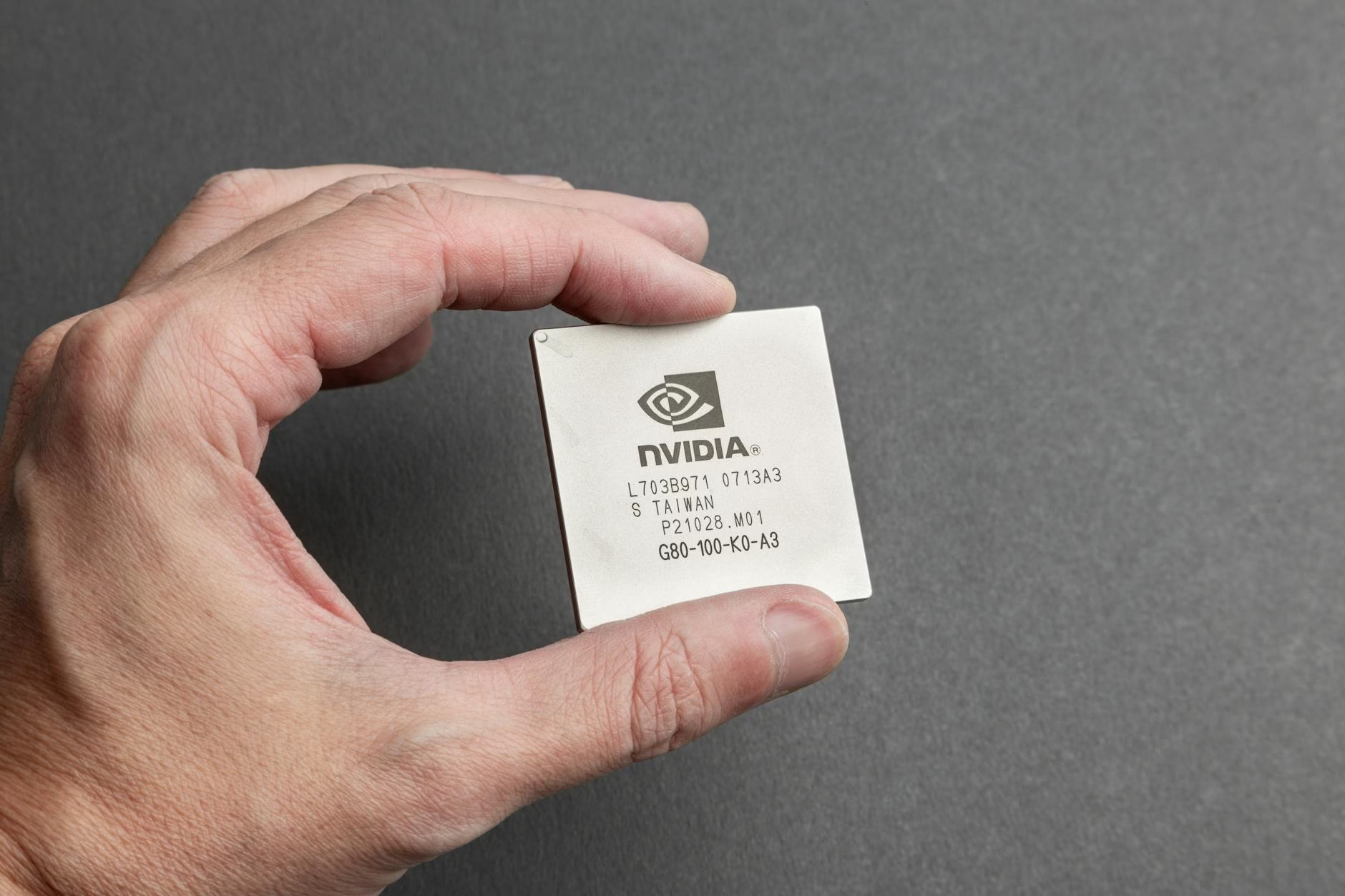
Last week, Google unveiled TurboQuant, a groundbreaking approach to reducing memory needs in artificial intelligence (AI). Instead of simply increasing memory capacity, TurboQuant aims to make AI models require less memory overall. This innovation could significantly impact how businesses manage their AI systems.

TurboQuant addresses a critical issue in large language models (LLMs) like GPT. These models generate text one token at a time, relying on complex calculations that consume substantial memory. By optimizing how these calculations are stored and processed, Google hopes to enhance performance while lowering costs.
Understanding TurboQuant
TurboQuant consists of two main stages: PolarQuant and QJL (Quantised Johnson-Lindenstrauss). PolarQuant compresses data by converting vectors into polar coordinates. This method takes advantage of predictable patterns in high-dimensional spaces, allowing for more efficient storage without needing extensive calibration.
The second stage, QJL, corrects any errors introduced during compression. It ensures that the model can still accurately compute attention scores without requiring additional memory. Together, these stages achieve a remarkable reduction in memory usage while maintaining accuracy.

Impact on AI Models
The implications of TurboQuant are significant for businesses using AI. For instance, it can reduce the size of key-value caches by up to six times without sacrificing performance. This means companies can serve more users simultaneously or support longer
contexts without needing expensive hardware upgrades.
Key takeaways
- TurboQuant reduces AI memory requirements by up to six times.
- This technology enhances performance without compromising accuracy.
- It can be applied across various industries beyond LLMs.
- Businesses may see cost savings and improved service capabilities.
Future Considerations
FAQs
- What is TurboQuant? TurboQuant is Google’s new algorithm designed to reduce memory requirements for AI models significantly.
- How does it improve efficiency? It compresses data using polar coordinates and corrects errors with QJL, achieving lower memory usage without losing accuracy.
- Who can benefit from this technology? Businesses using LLMs or any system relying on high-dimensional data can benefit from adopting TurboQuant.
Sources
For the original report, see the source article.